Case study:
UX/UI for the startup “Soundvest ” in Berlin
As part of my final project for UX/UI studies, I had the opportunity to work with a real startup, Soundvest, and provide design thinking expertise going through all steps.
Soundvest is a platform aimed at bridging the gap between musicians seeking high-quality instruments and investors seeking innovative investment opportunities.

Research
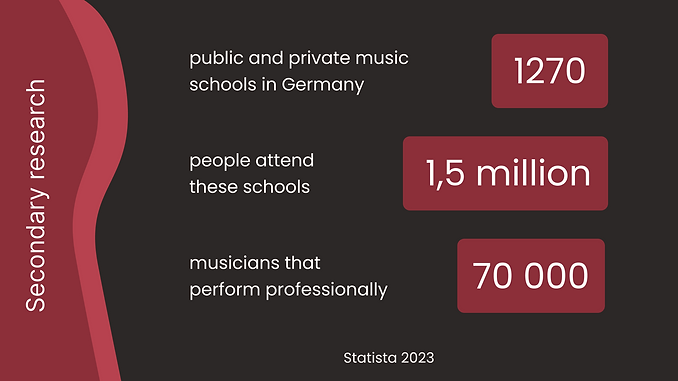
Initially, I decided to conduct a secondary research to corroborate the usefulness of the startup. My focus was primarily on the German market, as the owners' strategy is to establish a strong foothold in the local market and subsequently expand to a global scale to attract both musicians and investors worldwide.
As you can see on the screen, I discovered that the German market boasts a sizable audience with a significant number of individuals attending music schools and musicians performing at a professional level.
The following data is crucial in comprehending the unique problem our startup addresses. Professional string instruments cost a lot, that can be unaffordable for many musicians.

Survey
As part of my UX research, I conducted three surveys to gain a deeper understanding of our target audience.
It was important for me to consider the two categories of our audience, which include both beginners and expert musicians, as well as investors with varying levels of experience in the art industry.
Founders of the startup helped me a lot additionally, because before they had already gathered some information having conversations with people from the field.

These are some findings from the survey and interviews with investors.
Competitors
When inquiring about competitors, the startup founders shared that their field was quite unique, that is why they don't have direct competitors in Germany at all.
While this suggests that Soundvest has a unique market position, it can also be challenging because competitor insights are a valuable resource in understanding the industry.
But as I mentioned, currently, there are no direct competitors for Soundvest in Germany, presenting an opportunity for them to establish themselves as a leader in their field.

These companies were founded with a goal of providing access to unique and limited assets for everyone. Valuable assets are not easy to obtain. Researching, acquiring, insuring, storing, and maintaining them is not only costly, but also time-consuming and sometimes stressful.
But the most important is that these companies are not focused on music and musical instruments. Yes, they also can propose luxury instruments for investing, but it's not a big part of it. At the same time, they propose expensive cars, real estate, wine and so on. Meanwhile Soundvest is more focused on music, they want to bring an important input into field. It's supposed to a bridge between musicians and investors. It should solve problems of both.
Problem Statement and HMW

PB and HMW for investors
In general, for our company, I needed to create a problem statement and two "how might we" questions for two types of audiences, as we serve as a bridge between musicians and investors.
Based on previous information, I also needed to create two different user flows for both audiences.
Due to time constraints within the scope of my last project, I decided to focus more on the investor side since it was a higher priority for our clients.
User Persona and Journey Map
Let's come up to the most creative part of design thinking
From my observation not everybody is serious enough with creating Persona and itʼs daily flow, because it has a lot of fun to pretend that you have full access to somebody's life, goals, needs, frustrations etc. But User personas and User flows are important to UX design because they help designers understand that they work for a real person, who will interact with the product or service. it gives a sense of belonging to something alive and important, understanding you have responsibility to people.

Meet the Schmidt couple.
They are people who know what they are doing. Being advanced in financial industry they try to stay updated with the world of classical music. Music belongs to a sphere where they can have a rest from large amount of bureaucracy in life.
They met each other at music school in Hamburg, but both of them didn't continue the study to perform professionally. They remember all the struggles they came through in those ages and that is why want to help musicians to advance their career.At the same time they are common with investments and money is not a question anymore and here appears a need to have something more than just financial profit.

Mood board and Style Tile

The purpose of this moodboard is to capture the essence of something beautiful, exquisite, and creative. It's not the kind of creativity that involves recklessness. Classical music demands immense discipline, grace, and talent. Similarly, investors are often wise individuals who possess a deep patience and discipline.
The burgundy hue that dominates on pictures you could see before reminiscents of the wood commonly used to craft stringed musical instruments. At the same time, this deep red shade is expressiveness and the emotions it elicits.
In addition, you'll notice grand, refined halls where symphonies are performed by large orchestras.
Ultimately, this moodboard exudes a vintage vibe, celebrating the love of the classics, elegance, and intellect.

Part of Style Tile
For sure I also created a Style Tile, which purpose is to establish a visual language that will ensure consistency across all design components. I can't say it was easy and see much space for improvements in future.
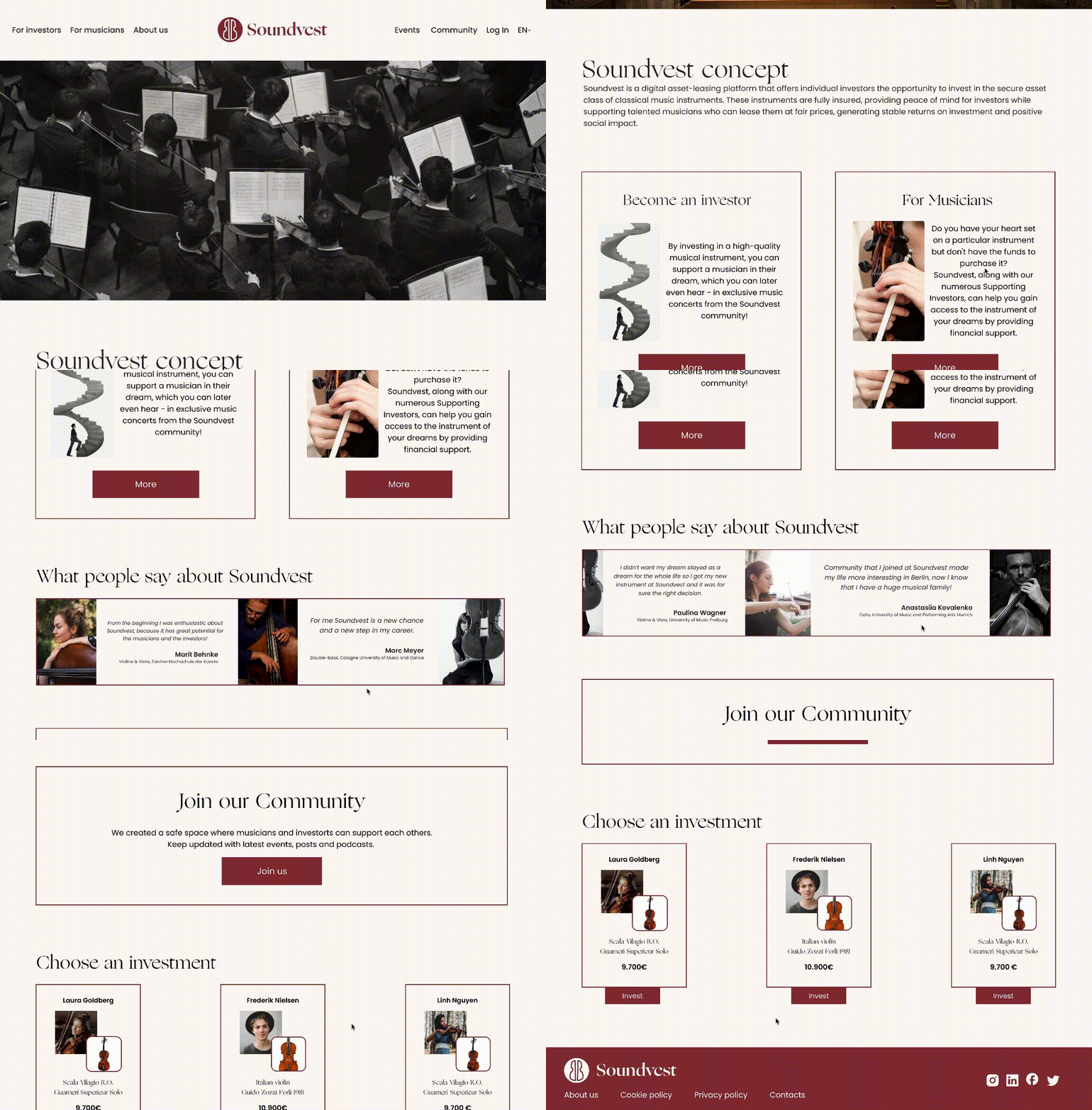
Hi-Fi Screens